
How Customer Support Teams Should Evaluate WhatsApp Business API Platforms for Multi-Channel Support
Your support team answers WhatsApp on one screen, Instagram DMs on another, and email in a third. Every channel switch costs an agent seconds, and those seconds compound across thousands of monthly conversations. Choosing a WhatsApp Business API platform that cannot unify them means paying for that friction indefinitely. A fuller comparison is available at com.bot.
This article walks through how to map your real conversation volume and channel mix, define non-negotiable SLA and compliance requirements, and evaluate unified inboxes, automation depth, and pricing transparency. You will finish with the exact questions to ask vendors and a structured pilot framework, so the decision rests on your workflow rather than a feature demo.
Start With Your Support Workflow, Not the Vendor's Feature List
Before comparing any platform, quantify how your team currently handles conversations across each channel. Vendors design demos to impress, and feature lists are written to sound exhaustive. Neither tells you whether a tool fits how your agents actually work.
A feature-driven purchase usually ends with paid capabilities nobody uses and gaps in the areas that matter daily. Starting from your own workflow reverses that. You enter every demo knowing what must work on day one.
The process has two steps. First, map your real conversation volume and channel mix. Second, define the requirements you cannot compromise on, such as response times, compliance, and data location. Everything else is a preference, not a need.
The baseline you build also becomes your measuring stick. When a WhatsApp Business Solution Provider claims faster handling or better routing, you can test that claim against your own numbers instead of accepting it at face value.
Map Your Actual Conversation Volume and Channel Mix
Pull 30 days of data from your help desk and messaging apps to calculate daily conversation counts per channel. Export ticket logs and message histories, then tally totals for WhatsApp, Facebook Messenger, Instagram, web chat, and email separately.
Raw counts are only the start. Note peak hours, average handling time per conversation, and how many messages arrive outside business hours. These patterns reveal where an omnichannel inbox and automated ticket creation would reduce manual work.
Then project forward. If volume has grown steadily, model the next two quarters at the same rate. A platform that works at your current load may strain once chat assignment and load balancing have more traffic to manage.
A simple tracking table keeps the exercise consistent across channels:
| Channel | Daily Conversations | Peak Hours | Avg. Handling Time | Projected Growth |
|---|---|---|---|---|
| Filled in from logs | Filled in from logs | Filled in from logs | Filled in from trend | |
| Facebook Messenger | Filled in from logs | Filled in from logs | Filled in from logs | Filled in from trend |
| Filled in from logs | Filled in from logs | Filled in from logs | Filled in from trend | |
| Web chat | Filled in from logs | Filled in from logs | Filled in from logs | Filled in from trend |
This baseline does double duty later. During platform evaluation, it lets you validate vendor claims about throughput, response time, and routing against numbers you collected yourself.
Define Non-Negotiables: SLA, Compliance, and Data Residency
List your must-have requirements around response times, data storage locations, and regulatory compliance. These are the criteria that eliminate vendors early, before feature comparisons pull you off course.
Response time targets come first. An example: 95 percent of messages answered within 15 minutes during business hours. If a platform cannot support SLA compliance reporting at that level, agent productivity discussions become secondary.
Compliance and residency follow. If your industry falls under GDPR or HIPAA, confirm where message data is stored and how it is processed. Data held in the EU or US may be a hard requirement depending on your legal obligations.
Separate true non-negotiables from nice-to-haves with one question: would we reject a platform that fails this? If the answer is no, it belongs on a wish list, not a shortlist.
Use a checklist to score each vendor consistently:
- Meets the 15-minute response target with reporting to prove it
- Supports required regulatory compliance, such as GDPR or HIPAA
- Stores data in your required region, such as the EU or US
- Provides CRM synchronization and customer context in the agent workspace
- Offers skill-based routing, chat assignment, and load balancing
- Handles message templates, interactive buttons, and media sharing
- Operates as a recognized Meta Business Partner or WhatsApp Business Solution Provider
Only after this checklist is settled should you compare canned responses, quick replies, or document exchange between shortlisted platforms. Those features improve conversational support, but they cannot compensate for a failed non-negotiable.
The Evaluation Criteria That Actually Matter for Multi-Channel Support
Focus your evaluation on three areas that directly impact agent efficiency and customer experience. Unified inbox and routing, automation depth, and pricing transparency separate platforms that scale from those that create new bottlenecks.
Get these three wrong and every added channel multiplies confusion. Get them right and multi-channel support becomes a genuine advantage for your customer support teams.
Unified Inbox and Agent Routing Across WhatsApp, Facebook, and Instagram
A true unified inbox lets agents see and reply to WhatsApp, Facebook, and Instagram messages without switching tabs. That single omnichannel inbox view is the foundation of an efficient agent workspace. Without it, agents juggle multiple windows and lose track of conversations.
When evaluating a platform, look beyond the marketing screenshots. Test how messages actually flow through the shared team inbox under realistic conditions.
- Single view for all channels: Confirm WhatsApp, Facebook, and Instagram conversations appear in one queue, not separate silos.
- Automatic assignment: Check whether the system routes conversations based on agent availability, skills, or current workload.
- Load balancing: Verify that chat assignment distributes volume evenly across teams during peak hours.
- CRM synchronization: Confirm customer context such as order history and past tickets appears alongside each message.
Run a practical test. Send a WhatsApp message and a Facebook message simultaneously, then check whether both land in the same queue with proper routing applied. Watch how the platform handles a third message when all agents are busy.
Skill-based routing matters most for specialized teams. A billing question should reach someone trained in billing, not just the next available agent. This directly affects response time, first contact resolution, and SLA compliance.
CRM synchronization deserves equal attention. If agents must open a separate tool to see who they are talking to, the unified inbox is only half finished.
Automation Depth: Bot Builders, Triggers, and Handoff to Human Agents
Evaluate how easily you can build a bot that answers FAQs, collects information, and passes complex issues to a human. Automation depth determines whether your team handles rising message volume without adding headcount.
Start with the bot builder itself. A drag-and-drop interface lets support managers build flows without engineering help. A builder that requires code for every change creates a dependency that slows everything down.
Next, examine triggers. Look for automation that fires on keywords, time of day, or customer behavior. Consider a bot that asks for an order number, then routes the conversation to billing with that number attached.
- Keyword triggers: Route messages containing terms like "refund" or "cancel" to the right team automatically.
- Time-based triggers: Send after-hours messages into a bot flow instead of leaving customers waiting.
- Seamless handoff: Ensure the human agent receives the full conversation history, not a blank screen.
- Message templates and interactive elements: Check support for quick replies, interactive buttons, list messages, and media sharing.
- Automated ticket creation: Confirm bot conversations convert into trackable tickets when escalation happens.
Test the handoff directly. Start a bot conversation and request a human agent midway through. If the agent cannot see what the bot already collected, customers will repeat themselves, and satisfaction drops.
Document exchange matters too. Customers often need to send screenshots or receipts. Confirm the platform handles media sharing cleanly within the automated flow.
Pricing Transparency: Per-Conversation Markups, Seat Fees, and Add-On Costs
Ask for a complete pricing breakdown that includes per-conversation fees, agent seats, and any add-ons. Pricing models vary widely, and unclear structures hide costs that surface only after you commit.
Request a sample invoice built around realistic numbers: 10,000 conversations per month, 10 agents, and the add-ons you expect to use. A vendor confident in its pricing will provide this without hesitation.
Compare the two common models carefully. Some platforms charge per conversation, which ties cost to volume. Others charge per agent seat, which ties cost to team size. Each model favors different usage patterns.
- Per-conversation fees: Clarify what counts as a conversation and when the counter resets.
- Markups on WhatsApp fees: Ask whether the platform adds a margin on top of standard WhatsApp conversation charges.
- Seat fees: Check whether supervisors, admins, or part-time agents need paid seats.
- Add-on costs: Price out extra channels, additional automation, reporting tools, and API integration limits.
- Overages: Confirm what happens when you exceed your plan's conversation or seat limit.
Markups on WhatsApp conversation fees are the most commonly missed cost. Since Meta sets baseline conversation pricing, a WhatsApp Business Solution Provider may add its own margin. Ask directly how that markup is calculated.
Build a simple comparison table for total cost of ownership across two or three vendors. Include base fees, projected overages, and every add-on. The cheapest headline price rarely stays cheapest at scale.
Questions to Ask Before You Commit
These three questions will quickly reveal a vendor's reliability and support quality. Before signing a contract, customer support teams should treat the answers as a preview of the entire working relationship.
Vendor responses to these questions indicate long-term viability. A provider that hesitates, deflects, or gives vague answers is showing you how they will behave after the deal closes. A provider with clear, documented answers is showing you a partner who can support multi-channel support at scale.
The three areas below cover partner status, technical reliability, and the practical path to going live. Together they form a compact platform evaluation checklist that saves weeks of guesswork.
Is the Provider an Official Meta Business Partner?
Verify if the vendor is listed as an official Meta Business Partner or WhatsApp Business Solution Provider. This status is not a marketing label. It reflects a formal relationship with Meta and carries real operational consequences.
Official partners receive reliable API access and faster issue resolution when something breaks. They also operate under Meta's compliance policies, which reduces the risk of sudden account restrictions. For customer support teams, that stability translates directly into predictable message routing and fewer service interruptions.
Check the Meta partner directory directly. Do not rely on a badge on the vendor's homepage. Red flags include vendors who claim partnership but do not appear in the official listing, or who describe themselves as "certified" without naming the certifying body.
Official status also affects message delivery quality and account safety. A non-partner reselling access through another provider adds an extra layer that can slow down troubleshooting and complicate SLA compliance. Ask for the partner tier as well, since tiers can indicate depth of integration and support priority.
How Does the Platform Handle Message Delivery, Uptime, and Security?
Ask for specific uptime guarantees, delivery rate statistics, and security certifications. Vague assurances like "high availability" are not enough for a platform that handles conversational support at scale.
Request concrete metrics in writing:
- A 99.9% uptime SLA with defined remedies if the target is missed
- Delivery rates above 99%, with data segmented by country or region
- Encryption standards, including TLS in transit and end-to-end encryption where applicable
- Compliance certifications such as SOC 2 or ISO 27001
Test delivery yourself by sending messages to different countries and observing arrival times and failures. This small exercise exposes routing weaknesses that a sales deck will never mention. It also shows how the platform handles media sharing and document exchange across borders.
Ask about data breach protocols. Who is notified, how quickly, and through what channel? What happens to stored conversation history if the contract ends? For teams handling sensitive customer data, these answers matter as much as delivery speed. Strong platforms publish security documentation and welcome scrutiny rather than avoiding it.
What Does Onboarding and Integration Actually Look Like?
Request a detailed onboarding plan that includes timelines, required resources, and integration steps. The quality of this plan predicts how smoothly your team reaches full production use.
Typical onboarding moves through several phases:
- Account setup and business verification
- Channel connection and phone number registration
- Bot building with message templates, quick replies, and interactive buttons
- Agent training on the shared team inbox and agent workspace
Ask specifically about CRM synchronization with tools like Salesforce or HubSpot, and whether an open API is available for custom work. Confirm what support exists during onboarding: a named contact, a shared channel, or a self-serve knowledge base. Teams that need automated ticket creation and skill-based routing should confirm these work with their existing help desk software before committing.
A reasonable timeline is roughly one week for setup and two weeks for testing, though complexity varies. Be cautious of vendors promising instant setup without documentation, sandbox access, or a staging environment. Fast claims often mean thin support once real API integration work begins.
How Com.bot Fits Into a Multi-Channel Support Stack
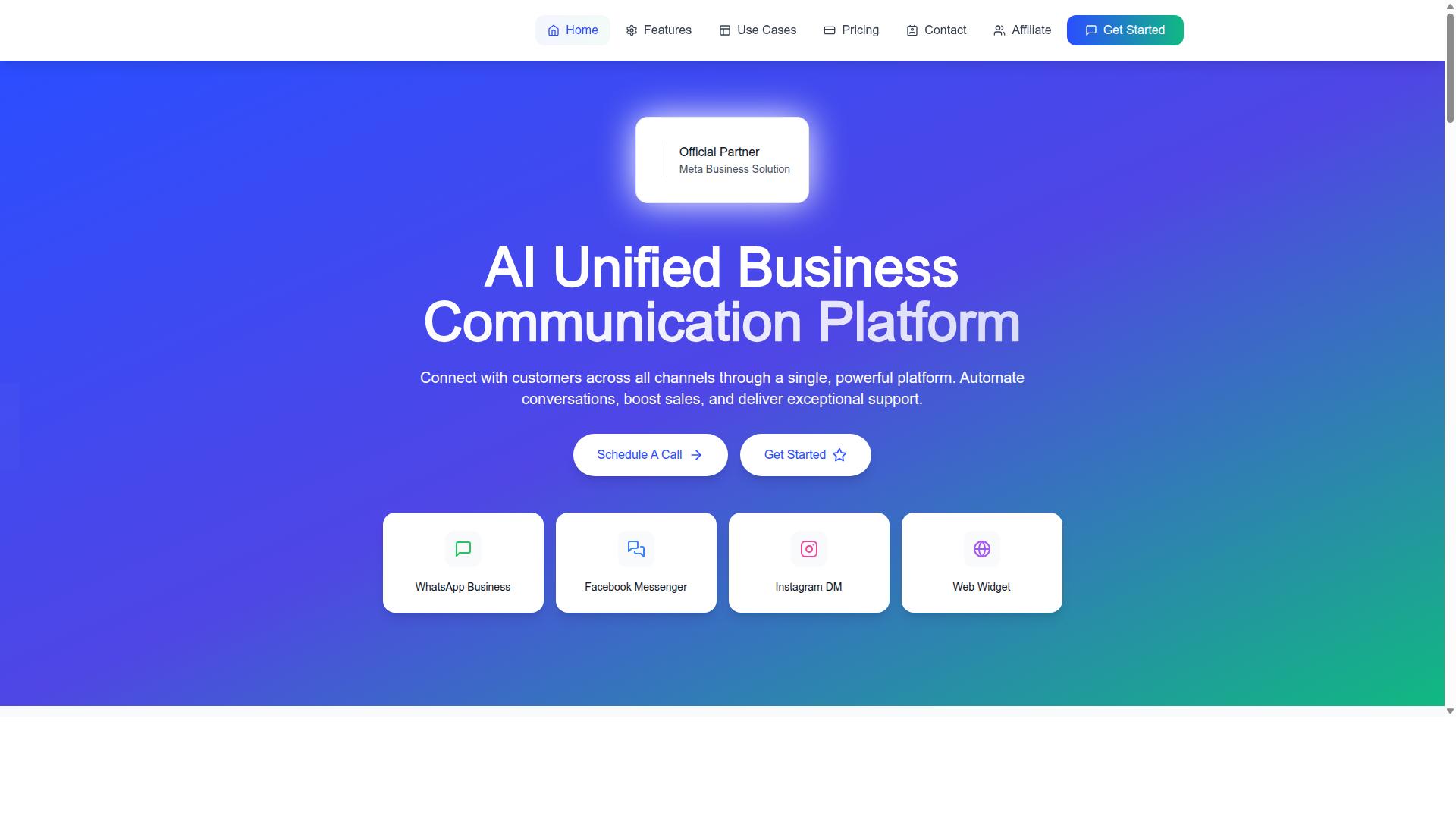
Com.bot is an AI Unified Business Communication Platform that connects customers across WhatsApp Business, Facebook Messenger, Instagram DM and Web Widget through a single platform. It is an Official Meta Business Partner with direct WhatsApp Business API integration, which places it in the category of platforms that meet the technical and compliance criteria customer support teams typically screen for during platform evaluation.
For teams weighing a WhatsApp Business Solution Provider, the practical question is whether one tool can serve as both the API gateway and the agent workspace. Com.bot answers that by combining automation, a shared team inbox, and multi-channel support in one system, rather than forcing support teams to stitch together separate tools for messaging, routing, and bot logic.
What follows is a closer look at how its channels, automation features, and pricing map to the evaluation criteria covered earlier in this guide. The goal is not to recommend a single vendor, but to show what a platform that satisfies the checklist looks like in concrete terms.
Channels, Automation, and Pricing at a Glance
Com.bot offers WhatsApp Business API integration, a unified team inbox, a visual bot builder, and native payments for WhatsApp transactions. Multi-channel support extends to WhatsApp, Facebook and Instagram, so an omnichannel inbox can hold conversations from all three in one place. The platform is owned and managed by Com Bot AI Limited.
On the automation side, the Visual Bot Builder uses a drag-and-drop interface, and the Automation Builder connects with 1000+ integrations. Together these support smart chatbots, notifications, order updates, payment collection, and bulk messaging. Team Collaboration includes role-based access, which matters for shared team inbox workflows and agent workspace governance.
Pricing is structured around quarterly plans, with add-ons charged per extra team member or channel:
- Silver: $149 per quarter
- Gold: $349 per quarter
- Platinum V1: $2500 per quarter
- Add-ons: $10 per month per additional team member or channel
These details map directly to the evaluation criteria from earlier sections. A Meta Business Partner designation addresses compliance and API reliability concerns. The unified inbox and role-based access cover shared team inbox and agent workspace needs, while the bot builder and integrations speak to automated ticket creation and CRM synchronization potential. With 23,000+ active customers, the platform also offers a track record that support teams can weigh against their own requirements for message routing, response time, and SLA compliance.
Running a Structured Pilot Before Full Rollout
A 30-day pilot with a small team and limited channels will reveal real-world performance. Choose two or three experienced agents who can give honest, detailed feedback. Connect only one or two channels so the team can isolate problems clearly.
Define success before the pilot starts. Write down what passing looks like, so the decision after 30 days is based on evidence rather than impressions.
- Assign a pilot lead who owns the evaluation
- Set a fixed start and end date
- Agree on target thresholds for each metric
- Schedule weekly check-ins with the agents involved
Keep the rest of the team on existing tools during the trial. This protects normal service levels and gives you a clean comparison group. A platform evaluation works best when the pilot runs alongside business as usual, not instead of it.
Metrics to Track During the Trial Period
Track response time, first contact resolution, and agent productivity to objectively evaluate the platform. Each metric tells you something different about whether the tool supports conversational support at scale.
| Metric | Target | What It Reveals |
|---|---|---|
| Average response time | Under 15 minutes | Speed of routing and chat assignment |
| First contact resolution | Above 70% | Quality of customer context and agent tools |
| SLA compliance | 95% or higher | Reliability of message routing and load balancing |
Most platforms include reporting dashboards that export these figures. Pull the same reports before the pilot and after it, then compare the two sets side by side. A shared team inbox that routes poorly will show up as slower response times almost immediately.
Numbers only tell part of the story. Ask agents directly about ease of use, how quickly they find customer context, and whether the agent workspace slows them down. Whether canned responses, message templates, and interactive buttons feel natural in daily work matters as much as any dashboard figure. If agents avoid a feature during the trial, that is a signal worth recording.
Recommended Resources: