
Paylines, ways and clusters
27 July 2026 · filed under Reels
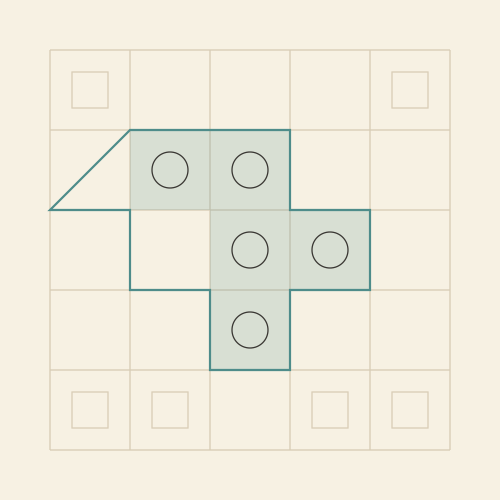
There are three common ways a machine decides that something has happened on screen. Knowing which one you are looking at changes what counts as a near miss and what is simply noise.
Every machine needs a rule for turning a screen full of symbols into an outcome. Three rules cover most of what is out there, and they lead to visibly different screens.
Lines
The oldest rule draws a fixed set of paths across the grid and only looks along them. A path might run straight across the middle row, or zigzag down and back up. Matching symbols count only if they sit on the same path, starting from the leftmost column. Everything off the path is scenery.
This is why a screen crowded with a symbol can still be worth nothing. The rule was never looking where you were looking.
Ways
The second rule drops the paths and asks only whether a symbol appears somewhere in each successive column, starting from the left. Position within the column stops mattering. This makes the screen much easier to read, because you can scan column by column instead of tracing lines.
Clusters
The third rule ignores columns altogether and looks for groups of the same symbol touching each other, usually edge to edge. Direction stops mattering, and the grid tends to be squarer to give groups room to form. It is the rule that makes a machine look least like its mechanical ancestors.
None of the three is more or less generous than the others by nature. They are different ways of reading the same screen, and each one produces its own idea of what an almost was.